Mars
The fourth planet — cold, dry, and rusted by iron oxide. Hosts the largest volcano (Olympus Mons) and the deepest canyon system (Valles Marineris) in the solar system.
Open Mars in the 3D Explorer →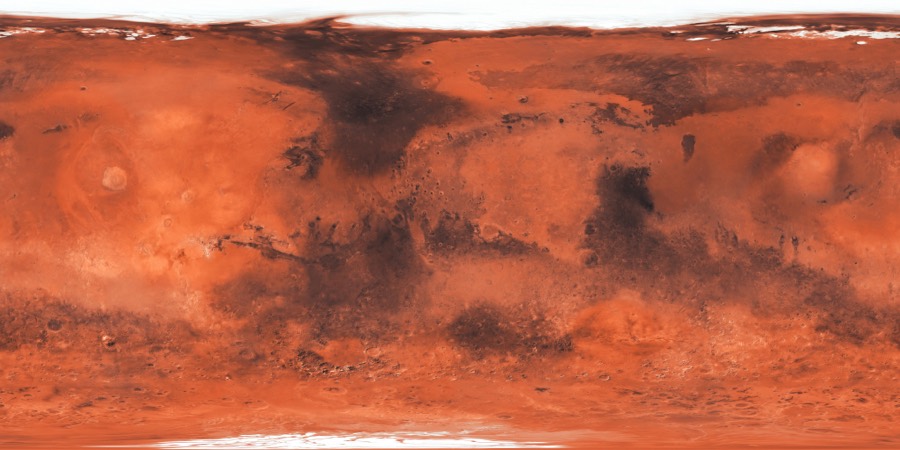
- PlanetType
- 3,389.5 kmRadius
- 1.52 AUDistance
- 24.6 hDay length
- 1.9 yrYear
- 25.19°Axial tilt
A Martian day is just 37 minutes longer than Earth’s.
Mars is the outermost of the four rocky planets and, for centuries, the most closely watched world in the night sky. It is half the diameter of Earth and colder than Antarctica, yet it remains the most Earth-like of our planetary neighbours — a place with seasons, polar ice caps, wandering dust storms, a day just over half an hour longer than our own, and unmistakable evidence that rivers and lakes once ran across its surface.
That combination is why Mars has drawn more robotic missions than any other planet, and why it sits at the centre of nearly every serious plan for sending humans beyond the Moon.
A landscape of extremes
Mars packs the most dramatic terrain in the solar system into a surface area no larger than the dry land on Earth. Olympus Mons, a shield volcano roughly the size of the U.S. state of Arizona, rises about 22 km — around two and a half times the height of Mount Everest — with a base so broad that, standing at its summit, you would see its flanks curve away below the horizon.
Slicing east from the volcanic Tharsis region is Valles Marineris, a canyon system more than 4,000 km long and up to 7 km deep — long enough to reach across the continental United States and deep enough to swallow the Grand Canyon many times over. Far to the south, the Hellas impact basin sinks some 7 km below the mean surface; the air at its floor is dense enough that liquid water could, briefly, be stable there.
A thin, cold, dusty atmosphere
Mars's atmosphere is about 95% carbon dioxide and less than 1% as dense as Earth's at sea level — thin enough that water on the open surface would boil away even while frozen, yet thick enough to drive real weather. Surface temperatures average near −60 °C but swing from a mild 20 °C at midday close to the equator to below −120 °C at the winter poles, where part of the atmosphere itself freezes into caps of solid CO₂, or 'dry ice', that grow and shrink with the seasons.
That same thin air fuels the planet's signature hazard: dust. Dust devils tower kilometres high, and every few Martian years a global storm can shroud the entire planet in haze for weeks — the event that silenced NASA's long-lived Opportunity rover in 2018 by starving its solar panels of sunlight.
The water story
Mars is dry today, but it was not always. Orbiters and rovers have mapped dried river valleys, fan-shaped deltas, ancient lakebeds, and clay and sulfate minerals that only form in the presence of water. Roughly 3.5 to 4 billion years ago, under a thicker and warmer atmosphere it later lost to space, Mars appears to have had flowing rivers, standing lakes, and perhaps a shallow northern ocean.
The water has not vanished so much as retreated underground and to the poles. The polar caps alone hold enough water ice to cover the planet in a shallow global sea, and radar has traced vast buried ice sheets at mid-latitudes. That accessible ice — a potential source of drinking water, breathable oxygen, and rocket propellant — is a central reason Mars is judged a plausible destination for long human stays. NASA's Perseverance rover is now caching rock cores from Jezero Crater, an ancient river delta, for a future mission to return to Earth.
Two small moons
Mars has two tiny, potato-shaped moons, Phobos and Deimos — probably captured asteroids or debris flung up by a giant impact. Phobos, the larger and closer, circles Mars so quickly that it rises in the west and sets in the east twice each Martian day. It is also spiralling slowly inward, and in perhaps 50 million years it will either strike the planet or be torn apart into a faint ring.
A history of exploration
No world beyond Earth has been studied so intensively. NASA's Mariner 4 returned the first close-up photographs in 1965, revealing a cratered, seemingly dead surface; the two Viking landers followed in 1976 with the first sustained surface operations and the first direct search for life. The age of roving opened with Pathfinder's small Sojourner in 1997 and grew with the twin rovers Spirit and Opportunity (2004), the car-sized Curiosity (2012), the InSight lander's marsquake seismometer (2018), and Perseverance, which in 2021 carried Ingenuity — the first aircraft ever to fly on another planet.
Mars has also become an international destination. Europe's Mars Express has orbited since 2003, the United Arab Emirates' Hope probe arrived in 2021, and China's Tianwen-1 delivered its Zhurong rover the same year. Overhead, a small fleet of orbiters continues to map the planet and relay data home from the machines working on the ground.
Why Mars is the target
Of all the places humans might one day live off Earth, Mars is the one most often proposed. A day close to our own, a genuine seasonal cycle, an atmosphere that offers some shielding from radiation and micrometeorites, accessible water ice, and abundant carbon dioxide that could be converted into fuel and oxygen make it uniquely suitable — if still extraordinarily difficult and dangerous. Temposia's Mars Mission experience visualises what such a journey could look like, from launch through cruise to arrival in orbit.
How to see Mars tonight
Mars is easy to find with the naked eye: a steady, distinctly reddish point of light that, unlike a true star, does not twinkle. It is brightest around opposition — when Earth passes directly between Mars and the Sun — which recurs roughly every 26 months and can briefly make Mars outshine everything in the night sky except the Moon and Venus. Through a small telescope near opposition you can make out a salmon-coloured disc, a bright polar cap, and the planet's largest dark markings.
By the numbers
| Type | Planet |
|---|---|
| Orbits | Sun |
| Mean radius | 3,389.5 km |
| Mass | 6.42 × 10²³ kg |
| Mean orbital distance | 1.52 AU |
| Orbital period | 1.9 yr |
| Rotation period | 24.6 h |
| Axial tilt | 25.19° |
| Orbital inclination | 1.85° |
| Surface temperature | Mean − 63 °C |
| Of note | Two tiny moons: Phobos and Deimos |