Jupiter
The largest planet — a gas giant of mostly hydrogen and helium, with 318 Earth-masses, 95 known moons, and the centuries-old Great Red Spot storm.
Open Jupiter in the 3D Explorer →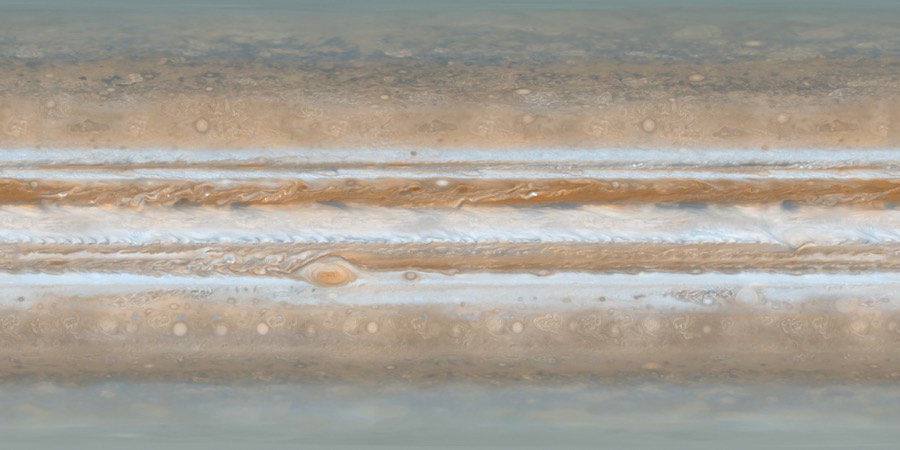
- PlanetType
- 69,911 kmRadius
- 5.20 AUDistance
- 9.9 hDay length
- 11.9 yrYear
- 3.13°Axial tilt
Jupiter spins so fast (under 10 hours) that its equator visibly bulges outward.
Jupiter is the giant of the solar system — a ball of hydrogen and helium so large that all the other planets could fit inside it with room to spare. At about 69,900 km in radius it is eleven times wider than Earth and, at 318 Earth-masses, more than twice as massive as every other planet combined. It has no solid surface to stand on: descend through its banded clouds and the gas simply grows hotter and denser until it behaves like a hot, electrically conducting liquid metal, all the way down to a diffuse core of heavier material blurred into the surrounding hydrogen.
For all its bulk, Jupiter is the fastest-spinning planet we know. A single day lasts under ten hours, and that furious rotation flings the equator outward into a visible bulge, giving the giant a slightly squashed, egg-like profile even in a backyard telescope.
A world made of weather
Jupiter has no crust, no continents, and no oceans of water — only a deep, turbulent atmosphere roughly 90% hydrogen and 10% helium, laced with traces of ammonia, methane and water. Its familiar face of cream and rust-coloured stripes is a pattern of alternating jet streams: bright 'zones' of rising gas and darker 'belts' of sinking gas, racing past one another at hundreds of kilometres per hour. Where they shear against each other, they spin off storms and eddies that can persist for years.
NASA's Juno orbiter, circling the planet since 2016, found that these winds are not a thin surface veneer. They plunge some 3,000 km into the interior before the churning atmosphere finally gives way to the electrically conducting fluid below. Juno also revealed clusters of cyclones arranged in geometric polygons around each pole — a pentagon of storms around the south pole and an octagon around the north, a form of weather with no parallel anywhere on Earth.
The Great Red Spot
Jupiter's signature feature is the Great Red Spot, a high-pressure storm so large it has been under continuous telescopic watch for well over a century; a similar spot was recorded in the 1660s, though recent work suggests that early storm may have been a separate one that later faded. It is an anticyclone, a storm rotating counter to Earth's low-pressure systems, with winds whipping around its rim at more than 400 km/h — and, by Juno's measurements, up to roughly 680 km/h. Juno's instruments showed its roots extend around 300 km down into the atmosphere, far deeper than any storm on Earth.
The spot is also shrinking. A century ago it was wide enough to swallow three Earths side by side; today it has narrowed to little more than a single Earth-width and grown more circular. Why it is contracting — and how it has endured for so long without an ocean or land to draw energy from — remains one of the planet's open questions.
A magnetic monster
Deep inside Jupiter, hydrogen is squeezed so hard that it turns into a metallic, electrically conducting liquid. Stirred by the planet's rapid spin, this layer acts as a colossal dynamo, generating the strongest magnetic field of any planet — roughly twenty times more intense than Earth's and vast enough to stretch millions of kilometres toward the Sun. If it glowed visibly, Jupiter's magnetosphere would appear larger than the full Moon in our sky.
That field traps a lethal belt of radiation and drives auroras at the poles hundreds of times more powerful than Earth's northern lights. It also couples to the volcanic moon Io, which feeds a doughnut of charged sulphur and oxygen into the system and lights up permanent auroral footprints in Jupiter's upper atmosphere.
A miniature solar system of moons
Jupiter presides over at least 95 known moons — a tally that keeps climbing as surveys turn up ever-smaller outer captures. Four of them stand apart: Io, Europa, Ganymede and Callisto, the Galilean moons that Galileo Galilei spotted through his telescope in January 1610. Watching them shuttle back and forth around Jupiter gave him the first direct evidence that not everything in the heavens orbits Earth.
These four are worlds in their own right. Io is the most volcanically active body in the solar system; Europa hides a salty ocean beneath its ice that may hold more water than all of Earth's seas; Ganymede is the largest moon anywhere, bigger than the planet Mercury and the only moon with its own magnetic field; and dark, battered Callisto preserves one of the oldest surfaces we know. Jupiter also wears a faint set of dusty rings, discovered by Voyager in 1979 and fed by debris knocked off its inner moons.
A history of visits
Jupiter was the first outer planet reached by spacecraft. NASA's Pioneer 10 flew past in 1973 and Pioneer 11 in 1974, confirming the planet's intense radiation and fluid nature. The twin Voyagers followed in 1979, discovering Io's volcanoes, Europa's icy shell and the ring system in a single pair of flybys. Galileo became the first orbiter in 1995, dropping a probe straight into the clouds and studying the moons for eight years.
Juno arrived on 4 July 2016 on a looping polar orbit built to dive beneath the radiation belts and probe the planet's interior, gravity and magnetic field. Its mission has since been extended to survey the Galilean moons up close. The next chapter is already under way: the European Space Agency's JUICE spacecraft, launched in 2023, is bound for Jupiter to focus on its ocean-bearing icy moons, alongside NASA's Europa Clipper, launched in 2024.
How to find Jupiter
Jupiter is one of the easiest objects to spot with the naked eye — a brilliant, steady, creamy-white point that outshines every star and is usually beaten only by the Moon and Venus. It reaches opposition, its brightest and closest, roughly every 13 months, when it rises at sunset and shines all night. Even ordinary binoculars will reveal the four Galilean moons strung out beside it in a line that visibly rearranges from night to night. A small telescope adds the dark cloud belts and, when it is turned toward us, the Great Red Spot itself.
By the numbers
| Type | Planet |
|---|---|
| Orbits | Sun |
| Mean radius | 69,911 km |
| Mass | 1.898 × 10²⁷ kg |
| Mean orbital distance | 5.20 AU |
| Orbital period | 11.9 yr |
| Rotation period | 9.9 h |
| Axial tilt | 3.13° |
| Orbital inclination | 1.305° |
| Of note | 95+ moons, the four largest are the Galileans |