Mercury
The smallest, fastest, and closest planet to the Sun. A scorched, airless rock with extreme day-night temperature swings — the only planet locked in a 3:2 spin–orbit resonance.
Open Mercury in the 3D Explorer →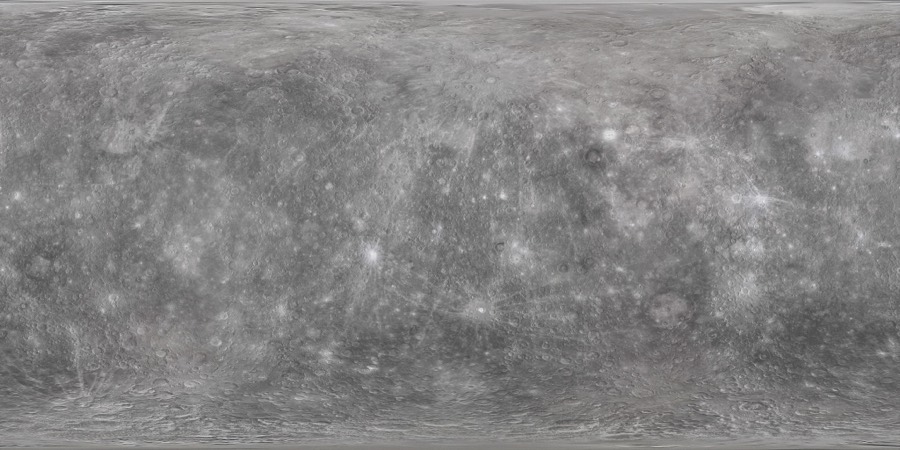
- PlanetType
- 2,440 kmRadius
- 0.39 AUDistance
- 58.6 daysDay length
- 88.0 daysYear
- 0.034°Axial tilt
A solar day on Mercury (sunrise to sunrise) lasts 176 Earth days — twice its year.
Mercury is the innermost planet and the smallest in the solar system, a scorched ball of rock only 4,879 km across — barely larger than the Moon and smaller than the moons Ganymede and Titan. It races around the Sun once every 88 days at an average distance of just 0.387 AU, closer than any other planet, yet its surface hides pockets of water ice that have survived for billions of years. Few worlds pack so many contradictions into so small a package.
For all its proximity, Mercury is one of the least-visited and, until recently, least-mapped planets. Its punishing nearness to the Sun makes it hard to reach and hard to observe, so that for decades much of its surface remained a blank. Only three spacecraft have ever gone there, and the picture they have returned is of a dense, iron-hearted, geologically strange world unlike any of its rocky neighbours.
An iron planet with a thin crust
Mercury's defining feature is buried out of sight. Beneath a rocky shell only a few hundred kilometres thick lies a metallic core so large it fills roughly 85% of the planet's radius — proportionally the biggest core of any planet in the solar system. That iron heart is why Mercury, despite being the smallest planet, is the second densest at 5.43 g/cm³, beaten only by Earth (which is compressed by its own greater gravity). Strip away that compression and Mercury is, by composition, the most metal-rich planet we know.
Why Mercury ended up so heavy remains debated. Leading ideas hold that a giant impact stripped away much of its original rocky mantle, or that the fierce heat and solar wind of the young Sun boiled off its lighter outer layers. Whatever the cause, that oversized core still stirs: Mariner 10 discovered in 1974 that Mercury generates a global magnetic field — about 1% the strength of Earth's, but the only such field among the inner rocky planets besides our own.
The 3:2 dance and the longest day
Mercury keeps time unlike anywhere else. It is locked in a 3:2 spin–orbit resonance: it turns exactly three times on its axis for every two trips around the Sun, so one rotation takes 58.6 Earth days and one orbit takes 88. The consequence is dizzying. A solar day on Mercury — from one sunrise to the next — stretches to 176 Earth days, exactly two Mercurian years. Stand in the wrong spot near perihelion and the Sun can appear to rise, stop, back up below the horizon, and rise a second time.
Its axis is also the straightest in the solar system, tilted a mere 0.034 degrees, so Mercury has no seasons at all. That upright spin, combined with the resonance, produces the planet's most extreme statistic: with almost no atmosphere to move heat around, the surface swings from about 427 °C in full daylight to −173 °C on the night side — the largest day-to-night temperature range of any planet.
A cratered, wrinkled surface
Mercury's face is ancient and battered, its most prominent scar the Caloris Basin — an impact crater roughly 1,550 km across, one of the largest in the solar system, gouged out about 3.9 billion years ago and ringed by mountains up to about three kilometres high. The blast was so violent that at the exact opposite point on the globe it threw up a jumbled zone of hills and grooves known informally as the 'weird terrain'.
The planet also carries features found nowhere else. As Mercury's huge core cooled and contracted, the whole planet shrank by several kilometres in radius, buckling the crust into long cliffs called lobate scarps that run for hundreds of kilometres. And scattered in bright patches are 'hollows' — shallow, irregular depressions with no lunar equivalent, thought to form where some volatile material in the rock is being vaporised away by the Sun even today.
Ice in the land of eternal shadow
The hottest planet by daytime is also, improbably, a place of permanent ice. Because Mercury barely tilts, the floors of some deep craters near its poles never see sunlight, and there the temperature stays cold enough to trap water ice for billions of years. Radar hinted at bright polar deposits in the 1990s, and NASA's MESSENGER confirmed in 2012 that they are dominantly water ice — somewhere between 100 billion and a trillion tonnes of it, partly buried under a dark, carbon-rich crust of organic-looking material. The likely source is a steady rain of comets and asteroids over the aeons.
Three visitors across fifty years
Mercury has drawn only a handful of missions, and reaching it is deceptively hard: a spacecraft falling toward the Sun gains so much speed that it must shed enormous energy to slow down and be captured. NASA's Mariner 10 made the first reconnaissance with three flybys in 1974–75, imaging less than half the surface and discovering the magnetic field. Nothing followed for more than three decades.
NASA's MESSENGER changed everything, entering orbit on 18 March 2011 and mapping the entire planet before deliberately crashing into it on 30 April 2015. It nailed down the polar ice, the core, and the surface chemistry. The story now continues with BepiColombo, a joint European (ESA) and Japanese (JAXA) mission launched in 2018 that has been slowly braking against the Sun's gravity with repeated flybys; after a thruster problem pushed back its schedule, it is due to settle into orbit around Mercury on 21 November 2026, carrying two orbiters to study the planet and its magnetic field in tandem.
How to spot Mercury
Mercury is visible to the naked eye, but it is the most elusive of the bright planets. Because it never strays far from the Sun in our sky — at most about 28 degrees — it is only ever seen low near the horizon in bright twilight, either shortly after sunset or shortly before sunrise, never in a fully dark sky. Astronomers call these best windows 'greatest elongations', and they recur every few weeks. Look for a steady, pinkish-white point of light hugging the horizon just after dusk or before dawn; a small telescope will reveal that Mercury, like the Moon, shows phases as it swings between us and the Sun.
By the numbers
| Type | Planet |
|---|---|
| Orbits | Sun |
| Mean radius | 2,440 km |
| Mass | 3.30 × 10²³ kg |
| Mean orbital distance | 0.39 AU |
| Orbital period | 88.0 days |
| Rotation period | 58.6 days |
| Axial tilt | 0.034° |
| Orbital inclination | 7.005° |
| Surface temperature | −173 °C night to 427 °C day |