Venus
Earth’s twin in size and mass, but the runaway-greenhouse cousin. A 96.5% CO₂ atmosphere traps heat under a permanent sulfuric-acid cloud deck.
Open Venus in the 3D Explorer →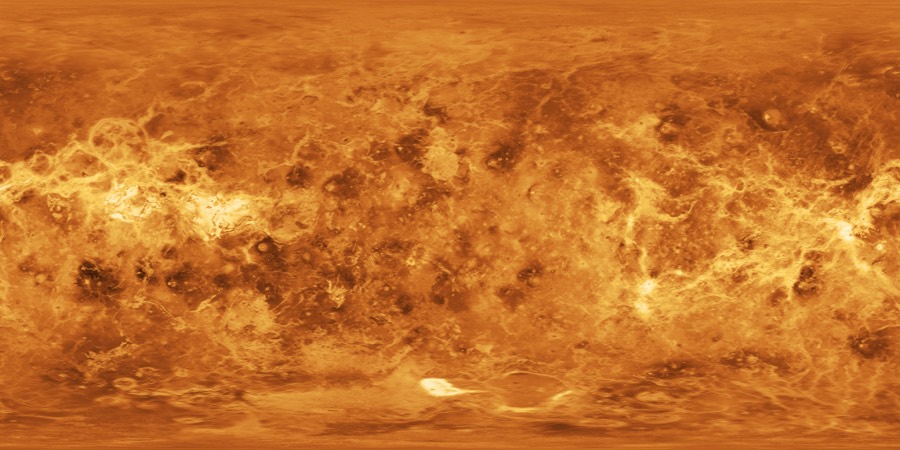
- PlanetType
- 6,051.8 kmRadius
- 0.72 AUDistance
- 243.0 days (retrograde)Day length
- 224.7 daysYear
- 177.36°Axial tilt
Venus rotates backwards relative to its orbit — and does so once every 243 Earth days.
Venus is the second planet from the Sun and, in almost every physical measure, Earth's near-twin: 6,051.8 km in radius against Earth's 6,371, and 4.87 × 10²⁴ kg against 5.97 × 10²⁴ — a difference of only a few percent in size and mass. Yet the resemblance ends at the surface. Beneath a permanent deck of sulfuric-acid cloud sits the hottest planetary surface in the solar system, hotter even than sunward Mercury, held near 465 °C by the most extreme greenhouse effect we know of.
It is a world of superlatives and inversions. Venus rotates backwards, so slowly that a single spin takes 243 Earth days — longer than its 224.7-day year. Its air is 96.5% carbon dioxide and presses on the ground with about 92 times Earth's sea-level pressure. For a planet so similar to ours in the raw ingredients, Venus is the sharpest lesson in the solar system on how differently two sibling worlds can turn out.
An atmosphere that crushes and cooks
Venus is wrapped in a dense envelope of almost pure carbon dioxide, with a few percent nitrogen and only trace amounts of everything else. At the surface the pressure reaches roughly 92 times Earth's — the force you would feel about 900 m underwater in the ocean — and that thick blanket of CO₂ traps heat with ruthless efficiency. Surface temperatures hold near 465 °C, hot enough to melt lead, and vary almost nowhere: pole to equator, day side to night side, the ground stays roughly the same searing temperature.
The clouds are not water but concentrated sulfuric acid, layered tens of kilometres thick and completely hiding the surface from ordinary cameras. Droplets of acid rain fall from the cloud base but evaporate in the heat long before reaching the ground, a phenomenon called virga. High above, the cloud tops race around the planet in just four Earth days, driven by winds measured as high as about 360 km/h — a 'super-rotation' that spins the atmosphere far faster than the sluggish body of the planet beneath it.
The runaway greenhouse
Venus is the textbook case of a runaway greenhouse. Sitting closer to the Sun than Earth, it likely received enough extra sunlight early on that any oceans evaporated; water vapour is itself a powerful greenhouse gas, so more warming drove more evaporation in a feedback loop until the water was gone entirely, lost to space after sunlight split it apart high in the atmosphere. What remained was carbon dioxide with nothing to lock it away, and the temperature climbed to where it sits today.
Compounding the situation, Venus has no global magnetic field to shield it, leaving its upper atmosphere exposed to the solar wind. Understanding exactly how and when Venus diverged from Earth is one of the central questions in comparative planetology, because it bears directly on how we judge the climates of both our own world and Earth-sized planets around other stars.
A young, volcanic surface
When NASA's Magellan orbiter mapped Venus with radar between 1990 and 1994, piercing the clouds for the first time, it revealed a surface dominated by volcanism. Roughly 80% of the planet is smooth volcanic plains, studded with hundreds of coronae — circular tectonic-volcanic features, some over 1,000 km across, formed where hot plumes push up from the mantle. Two highland 'continents' rise above the plains: Ishtar Terra in the north, about the size of Australia, and the larger Aphrodite Terra near the equator.
Ishtar Terra carries Maxwell Montes, the highest point on Venus, whose peak stands some 11 km above the mean surface — comparable to the scale of the Himalayas. Remarkably, Venus wears very few impact craters, and those it has are evenly scattered and fresh-looking. That points to a planet-wide resurfacing event a few hundred million years ago that erased the older cratering record, and recent re-analysis of Magellan data has found signs that some volcanoes may still be active today.
A backwards day longer than its year
Venus spins on its axis in the opposite direction to its orbit and to most other planets — a retrograde rotation reflected in its axial tilt of 177.36°, essentially upside down. That spin is glacially slow, one turn every 243 Earth days, so a Venusian sidereal day is actually longer than its 224.7-day trip around the Sun. Combined with its orbital motion, the interval from one sunrise to the next works out to about 117 Earth days. Standing on the surface, you would see the Sun rise in the west and set in the east.
Why Venus turns backwards is still debated. A giant impact early in its history could have flipped or reversed the planet, but a leading alternative holds that strong solar tides acting on its massive atmosphere gradually braked and reversed an originally Earth-like spin over billions of years.
A century of exploration
Venus was the first planet visited by a spacecraft, when NASA's Mariner 2 flew past in 1962. The Soviet Venera programme then achieved a string of firsts through the 1960s, 70s and 80s, including the first soft landing on another planet and the first photographs from the Venusian surface — cameras that survived only minutes to about an hour in the crushing heat and pressure before failing. NASA's Magellan followed with its global radar map, launched in 1989. More recently, Japan's Akatsuki orbiter, launched in 2010, entered orbit in 2015 to study the atmosphere and its super-rotating winds.
After a long lull, Venus is again a priority. A 2020 report of phosphine in the clouds — a possible, though heavily disputed, chemical hint of life — helped revive interest, alongside longstanding proposals that the temperate cloud layer near 50 km altitude, where pressure and temperature approach Earth's, could in principle host microbes. Three major missions are now in preparation for launch in the early 2030s: NASA's DAVINCI, which will drop a probe through the atmosphere, and the radar mappers VERITAS (NASA) and EnVision (ESA).
How to see Venus tonight
Venus is the easiest planet to spot and the third-brightest object in our sky after the Sun and Moon, bright enough to cast faint shadows and to be glimpsed in daylight if you know where to look. Because it orbits closer to the Sun than we do, it never strays far from it, appearing either in the west after sunset or in the east before sunrise — earning it the old names Evening Star and Morning Star. Through even a small telescope, Venus shows crisp phases like the Moon, waxing and waning as it circles the Sun; its highly reflective clouds are why it shines so brilliantly. Its rarest appearance is a transit across the face of the Sun, which comes in pairs eight years apart, then not again for over a century — the last were in 2004 and 2012, and the next will not occur until December 2117.
By the numbers
| Type | Planet |
|---|---|
| Orbits | Sun |
| Mean radius | 6,051.8 km |
| Mass | 4.87 × 10²⁴ kg |
| Mean orbital distance | 0.72 AU |
| Orbital period | 224.7 days |
| Rotation period | 243.0 days (retrograde) |
| Axial tilt | 177.36° |
| Orbital inclination | 3.395° |
| Surface temperature | ~465 °C — hottest surface in the solar system |