Earth
The third planet, the only world known to host life, and the only one with liquid surface water and a magnetic field strong enough to deflect the solar wind.
Open Earth in the 3D Explorer →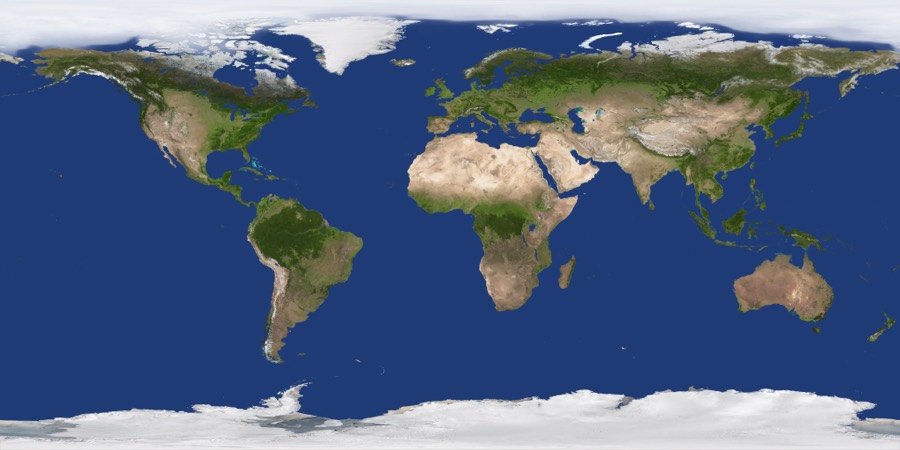
- PlanetType
- 6,371 kmRadius
- 1.00 AUDistance
- 23.9 hDay length
- 1.0 yrYear
- 23.44°Axial tilt
Earth is the densest planet in the solar system at 5.51 g/cm³.
Earth is the third planet from the Sun and, by every measure we can currently apply, the most remarkable object in the solar system: the only world known to hold liquid water on its surface, the only one wrapped in an oxygen-rich atmosphere, and the only place anywhere confirmed to be inhabited by living things. It is a rocky planet 12,742 km across, orbiting at essentially 1 astronomical unit, and although it looks modest beside the gas giants, it is the densest planet of them all at 5.51 g/cm³.
What sets Earth apart is not any single record but the way a handful of ordinary-seeming numbers — its distance from the Sun, its 23.44° tilt, its molten iron heart, its 24-hour spin — combine to keep the surface temperate, shielded, and wet enough for a biosphere to have persisted for billions of years.
A layered, restless interior
Cut Earth open and you find four nested shells. At the centre sits a solid iron-nickel inner core about 1,220 km in radius — smaller than the Moon but hot enough to melt, held solid by crushing pressure. Around it churns a liquid outer core, then a thick, slowly convecting rocky mantle some 2,900 km deep, and finally a thin skin of crust — only about 5 km of basalt beneath the oceans, up to 70 km of lighter granite-rich rock under the continents.
That thin crust is broken into a jigsaw of tectonic plates that grind, dive, and spread apart over the mantle beneath. Earth is the only planet where this kind of plate tectonics is known to operate today, and it matters far beyond geology: subduction recycles carbon between rock, ocean, and air, acting as a planetary thermostat that has kept the climate broadly habitable across deep time. The same interior heat drives the earthquakes and volcanoes that constantly resurface the planet, which is why Earth — unlike the Moon or Mars — wears so few ancient impact craters.
The magnetic shield
The swirling liquid iron of the outer core, stirred by convection and Earth's rotation, works as a self-sustaining geodynamo that generates a global magnetic field. That field balloons outward into a vast magnetosphere — compressed on the Sun-facing side and drawn out into a long tail on the night side — that deflects the solar wind, the stream of charged particles the Sun blows past us at hundreds of kilometres per second.
Without it, that wind would gradually strip the atmosphere away, much as is thought to have happened on Mars once its own dynamo faded. The magnetosphere also traps energetic particles in the doughnut-shaped Van Allen belts and funnels others toward the poles, where they slam into the upper atmosphere and light it up as the aurora. The field is not fixed: it wanders, weakens, and over geological time has fully reversed polarity many times, a history frozen into the magnetised rock of the seafloor.
An ocean world with a breathable sky
Liquid water covers about 71% of Earth's surface, in oceans averaging some 3.6 km deep — the defining feature no other planet shares. Earth sits in the Sun's habitable zone, close enough that water does not freeze solid and far enough that it does not all boil away, and its atmosphere supplies just enough pressure and greenhouse warming to hold the mean surface temperature near a mild 15 °C.
That atmosphere is about 78% nitrogen and 21% oxygen, with the small remainder — carbon dioxide, water vapour, argon — doing outsized work. The free oxygen is itself a fingerprint of life: it was pumped into the air by photosynthesising microbes over billions of years, and high above, a fragile layer of ozone built from that oxygen screens out much of the Sun's ultraviolet radiation. Earth is, in effect, a planet visibly re-engineered by its own biosphere.
Days, years, and seasons
Earth turns on its axis once every 23.93 hours relative to the stars — the sidereal day — giving a solar day of very nearly 24 hours, and completes one orbit of the Sun in 365.256 days. Its axis is tilted 23.44° from the vertical, and that tilt, not any change in distance from the Sun, is what creates the seasons: through the year each hemisphere leans alternately toward and away from the Sun, lengthening or shortening the days and raising or lowering the noon sun.
The tilt stays remarkably steady over long timescales, stabilised by the gravitational anchor of an unusually large Moon. That constancy has spared Earth the wild swings in climate that a freely wobbling axis could produce — one more quiet condition that has helped life endure.
A single large Moon
Earth has one natural satellite, the Moon, and it is enormous relative to its planet — more than a quarter of Earth's diameter, the largest moon-to-planet ratio among the major planets. It most likely formed about 4.5 billion years ago when a Mars-sized body struck the young Earth and flung a disc of debris into orbit, which coalesced into the Moon we see.
Its gravity raises the ocean tides, and the friction of those tides is slowly braking Earth's spin while nudging the Moon outward by about 3.8 cm a year. Over hundreds of millions of years that means Earth's days are gradually growing longer — a slow, ongoing exchange written into the planet's rotation.
Studying our own planet
Earth is the one world we can study from the inside, but the space age turned it into an object of observation as well. The first views of the whole planet — the 1968 Earthrise photograph from Apollo 8 and the 1972 Blue Marble from Apollo 17 — reframed it as a small, finite oasis, and helped launch modern environmental science. Today a fleet of satellites watches Earth continuously, mapping oceans, ice, vegetation, weather, and a changing climate.
It remains the essential reference point for planetary science: every other world we explore is measured against Earth's mass, its density, its temperature, and above all its living surface. Understanding what makes this planet work is the yardstick by which we judge how rare — or how common — habitable worlds might be.
By the numbers
| Type | Planet |
|---|---|
| Orbits | Sun |
| Mean radius | 6,371 km |
| Mass | 5.972 × 10²⁴ kg |
| Mean orbital distance | 1.00 AU |
| Orbital period | 1.0 yr |
| Rotation period | 23.9 h |
| Axial tilt | 23.44° |
| Orbital inclination | 0° |
| Surface temperature | Mean ~15 °C |
| Of note | One natural moon |